
Cary NC Neighborhoods Guide (2026): West vs East, Prices and Taxes


Cary is doing something Durham isn't: holding. Prices are essentially flat year over year, homes are moving in twenty days, and sellers are getting 99.6% of asking. Volume is up 19%. That's a market in balance, not one in retreat.
Cary at a glance
Median sale price: $644,677 — down 0.8% year over year
Median days on market: 20 — down 2 days from 2025
Sale-to-list ratio: 99.6% — up 0.3 points
Homes sold: 733 — up 19.2% year over year
Median price per square foot: $255
Redfin, three months ending July 2026.
What the town-wide number hides is a $128,000 spread between West Cary and East Cary — and about twenty-two days' difference in how fast they sell. Those two halves of town are separate decisions with separate strategies, and the median is the average of a fast, new, expensive west and a slower, older, more negotiable east.
Here's how I'd break the town down for a buyer, with the reporting period next to every figure. Cary's neighborhood-level data is thinner than the town-level data and some cuts lag by months, so treat any single median as a starting point and let me pull live comps for the streets you're actually considering.
West Cary (27519)
The expensive, fast half of town. Amberly, Cary Park, Carpenter Village, Highcroft, Weycroft, Green Level — most of it built after 2000, much of it after 2015.
Median sale price: $729,601 (up 5.7%)
Days on market: 18
Price per square foot: $273
Sold over list: 30.7%
Three months ending June 2026
West Cary is where the town's price growth actually lives. Up 5.7% year over year while the town overall was flat, 18 days on market, and 30.7% of homes selling above list on 359 sales — a third more transactions than last year. If you're shopping here you are not the only one.
You're buying transitional, modern farmhouse, and craftsman-influenced houses on planned-community lots, usually with an HOA and usually with amenities attached — pools, trails, clubhouses. The appeal is straightforward: nothing needs redoing, and RTP is a short drive. I've written a full West Cary neighborhood guide if you want the community-by-community breakdown.
One thing that catches people: a portion of Cary's western edge sits in Chatham County, not Wake. Different county tax rate, different school system, same town services. It's a real difference in your annual carrying cost and in which district a child is assigned to, and it isn't always obvious from a listing. Confirm the county on the parcel record before you get attached.
The trade-off: you pay $273 a foot — 7% above the town median — for houses that won't ask you for money, in a submarket where you'll likely compete. Lots are smaller and the streetscape is newer and more uniform than east of town.
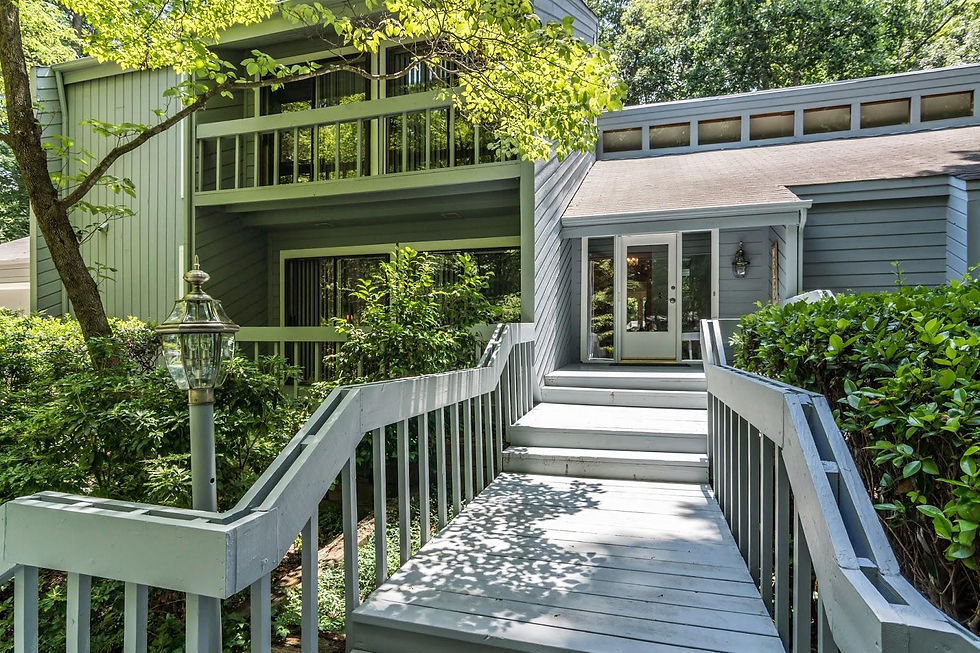
Preston, MacGregor, Lochmere and Kildaire Farms
Cary's 1980s and 90s core — mature hardwoods, larger lots, golf-course frontage in places, and the best renovation math in town.
This is the part of Cary I get most animated about, because it's where an interior architecture background actually changes the outcome. At roughly the same purchase price, West Cary buys you a finished 2019 house on a modest lot; Preston or Lochmere buys you a 1988 house on a bigger lot under grown trees, with a floor plan built for how people lived in 1988 — formal living room you'll never sit in, a kitchen closed off from everything, a primary bath with a garden tub eating the footprint.
That's not a defect. It's leverage, if you know what walls do what. Most of these houses have one or two structural moves — opening the kitchen to the family room, reworking a primary bath — that change how the whole house lives for a fraction of what the equivalent square footage costs new. The mistake I see is buyers pricing the renovation off a Pinterest board instead of off what's load-bearing. Walk it with someone who can tell you which changes are cosmetic and which need an engineer, before you write.
These neighborhoods also have amenity structures that vary a lot — some tie to golf or swim-and-tennis memberships with their own dues, separate from the HOA. Ask what's mandatory versus optional; it's a meaningful monthly number.
The trade-off: land and trees you cannot buy new in Cary, in houses that will need work and systems approaching end of life. Worth it if you'll actually do the renovation; expensive if you won't.
Downtown Cary
The part of town that changed most in the last five years — and the only part where "walk to dinner" is a real feature.
Between the Downtown Cary Park and the restaurants and shops that followed it, downtown went from a place people drove through to a place people drive to. That has shown up in what buyers will pay for the blocks around it.
What's for sale here is two things at once: older detached houses on small in-town lots, and newer infill townhomes built to catch exactly this demand. They behave differently at resale, and I'd think hard about which one you're buying. The townhomes are lower-maintenance and priced accessibly for the location; the older houses are the scarcer asset and generally the better long-term hold, with the maintenance profile to match.
Note that most published market data folds downtown into East Cary, so there's no clean separate median to quote. When I price a downtown property I'm working from a hand-picked comp set, not a neighborhood average — the walkability premium is real but it's block by block.
The trade-off: the only genuinely walkable option in Cary, on the smallest lots, with the least reliable published pricing and the widest range of product quality within a few blocks.
East Cary (27511)
Older, closer to Raleigh, slower to sell — and about $128,000 cheaper at the median than the west side.
Median sale price: $601,500 (up 3.7%)
Days on market: 40
Price per square foot: $259
November 2025 — ask me for a current read
Forty days on market against West Cary's eighteen, and homes trading around 2% under list. If you want to negotiate in Cary, this is where the market lets you. The stock is older and more varied — ranches, split-levels, 1970s and 80s two-stories — which means more diligence per house but also more chance of finding something mispriced.
Two live factors here. Fenton has been a genuine amenity for this side of town and is reflected in what nearby properties command. The former Cary Towne Center site is the opposite story: Epic Games bought it for a headquarters, the 2024 completion target came and went, the rezoning request was withdrawn in January 2025, and as of spring 2026 the property still sits vacant and fenced with no announced timeline. If you're buying near it, buy on the house and the street as they are today — not on what that site might become.
East Cary's proximity to Raleigh is its structural advantage. If your commute runs to downtown Raleigh or the Wake County side, the drive from here is materially shorter than from Green Level, and you're paying less per foot for the privilege.
The trade-off: the best value and the most negotiating room in Cary, in older houses that need real inspection scrutiny — and the most published-figure lag.
Cary's tax rate is going up — two years running
For fiscal 2027, Cary adopted a municipal rate of 36.75 cents per $100 — a 2.75-cent increase, about 8%, which the town estimated at roughly $15 a month more for the average homeowner. That follows an increase the prior year, from 32.5 to 34 cents. Two consecutive raises inside a $573 million budget.
Cary is still not the outlier in the region. The town's rate sits below Raleigh's 37.2 cents and above Holly Springs' 34.35. Add Wake County's 53.71 cents and a Cary homeowner is paying about 90.46 cents per $100 combined.
Cary, Wake portion (FY 2026–27): county $0.5371 + town $0.3675 = $0.9046 per $100
Durham, inside city limits (FY 2026–27): county $0.5792 + city $0.4371 = $1.0163 per $100
On a $700,000 Cary house, the combined rate works out to roughly $6,332 a year, or about $528 a month riding inside your escrow. That's not a rounding error in an affordability calculation, and it's the line item most likely to change after you close.
Two practical notes. First, if your house is on the Chatham County side of Cary, none of the Wake math above applies — different county rate entirely. Second, if you're buying near the top of your approval, ask your lender what rate they used in the escrow estimate. A quote built on last year's rate will under-collect, and you'll get an escrow shortage notice about fourteen months after closing, right when you thought the budget had settled.
Cary or Durham?
More of my buyers are running this comparison than a year ago, so here it is straight, same source and same period — three months ending July 2026.
Median sale price: Cary $644,677 · Durham $424,787
Median days on market: Cary 20 · Durham 31
Sale-to-list ratio: Cary 99.6% · Durham 98.6%
Year-over-year price: Cary −0.8% · Durham −2.3%
What Cary gets you: a more uniform, newer housing stock, which makes two houses genuinely comparable and makes pricing more predictable. Flatter year-over-year performance. And a market where inventory moves — 733 sales in a quarter, up 19%, which matters as much on the way out as on the way in.
What it costs you: about $220,000 at the median, eleven fewer days to decide, and a full point less negotiating room. If your budget tops out around $500,000, Cary puts you in townhomes or the older east side; the same money in Durham buys a detached house with a yard. That's the whole trade, and which way it goes depends on your commute and whether you want to renovate.
On schools: Wake County assigns by address, offers year-round and traditional calendars at different schools, and reassigns periodically. Don't rely on a listing's school field — pull the current base assignment for the exact address on the WCPSS lookup, and check it again before closing if you're buying for a particular school year. If the address is on Cary's Chatham County side, it's a different district entirely.
On commuting: West Cary to RTP and East Cary to downtown Raleigh are two different lives. Drive your actual route at your actual departure time before you commit to a side of town — it's the single cheapest piece of due diligence available to you.
If you're selling in Cary this fall
The town-wide 20-day median is not your number. West Cary sellers are working an 18-day, competitive market where roughly a third of homes clear above list — price to generate competition and you'll likely get it. East Cary sellers are working a 40-day market where the average home settles about 2% under asking, and the strategy is different: sharper pricing up front, because the negotiation is coming either way and you'd rather have it from a position of interest than after three price drops.
In the established 1980s and 90s neighborhoods, the highest-return prep isn't a full renovation — it's the smallest set of moves that stops a buyer from mentally pricing a gut job. Usually that's paint, lighting, and whatever makes the kitchen read as current. I'll walk a house and tell you which three things to spend on and which to leave alone; that conversation is generally worth more than the staging budget.
Common questions
What's the median home price in Cary, NC?
$644,677 for the three months ending July 2026, down 0.8% year over year, at a median $255 per square foot. West Cary runs higher at $729,601; East Cary lower at $601,500.
Is West Cary or East Cary better value?
East Cary is cheaper per foot ($259 vs $273) and far more negotiable — 40 days on market versus 18, with homes typically selling about 2% under list. West Cary costs more and moves faster, but the housing stock is newer and needs less work. Value depends on whether you want to renovate and where you commute.
Did Cary raise property taxes?
Yes. Cary adopted a 36.75-cent municipal rate for FY2027, up 2.75 cents (about 8%) — roughly $15 a month more for the average homeowner — after raising it from 32.5 to 34 cents the year before. Combined with Wake County's 53.71 cents, Cary homeowners pay about 90.46 cents per $100 of assessed value.
Is part of Cary in Chatham County?
Yes. A portion of Cary's western edge falls in Chatham County rather than Wake, which means a different county tax rate and a different school district while still receiving Town of Cary services. Always confirm the county on the parcel record before assuming Wake County rates or school assignments apply.
What's happening with the old Cary Towne Center site?
Epic Games purchased the site for a headquarters campus with a 2024 completion target. That target passed, the rezoning request was withdrawn in January 2025, and as of spring 2026 the property remains vacant and fenced with no announced timeline. If you're buying nearby, value the property on current conditions rather than on projected development.
How much house does $700,000 buy in Cary?
Around $700,000 is roughly the West Cary median, so it buys a newer detached house in a planned community there. In East Cary or the established 1980s–90s neighborhoods, the same money buys more square footage and a larger lot in an older house that will likely want updating.
Deciding between two sides of town?
I'll pull live comps for both, run your real commute from each, check the county and school assignment on the specific parcel, and walk any older house with you to price what it would actually take to update it. Blue Orchid Realty represents buyers and sellers across the Triangle — and lists at a 1.5% listing fee.
Sources
Tax rates — Triangle FY 2026–27 rate changes
Cary Towne Center / Epic Games — WRAL investigation, April 2026
Town of Cary — Fenton, Downtown Cary Park
Comments