
RTP 3.0: What Could It Mean for Cary, Morrisville & Durham Home Values?

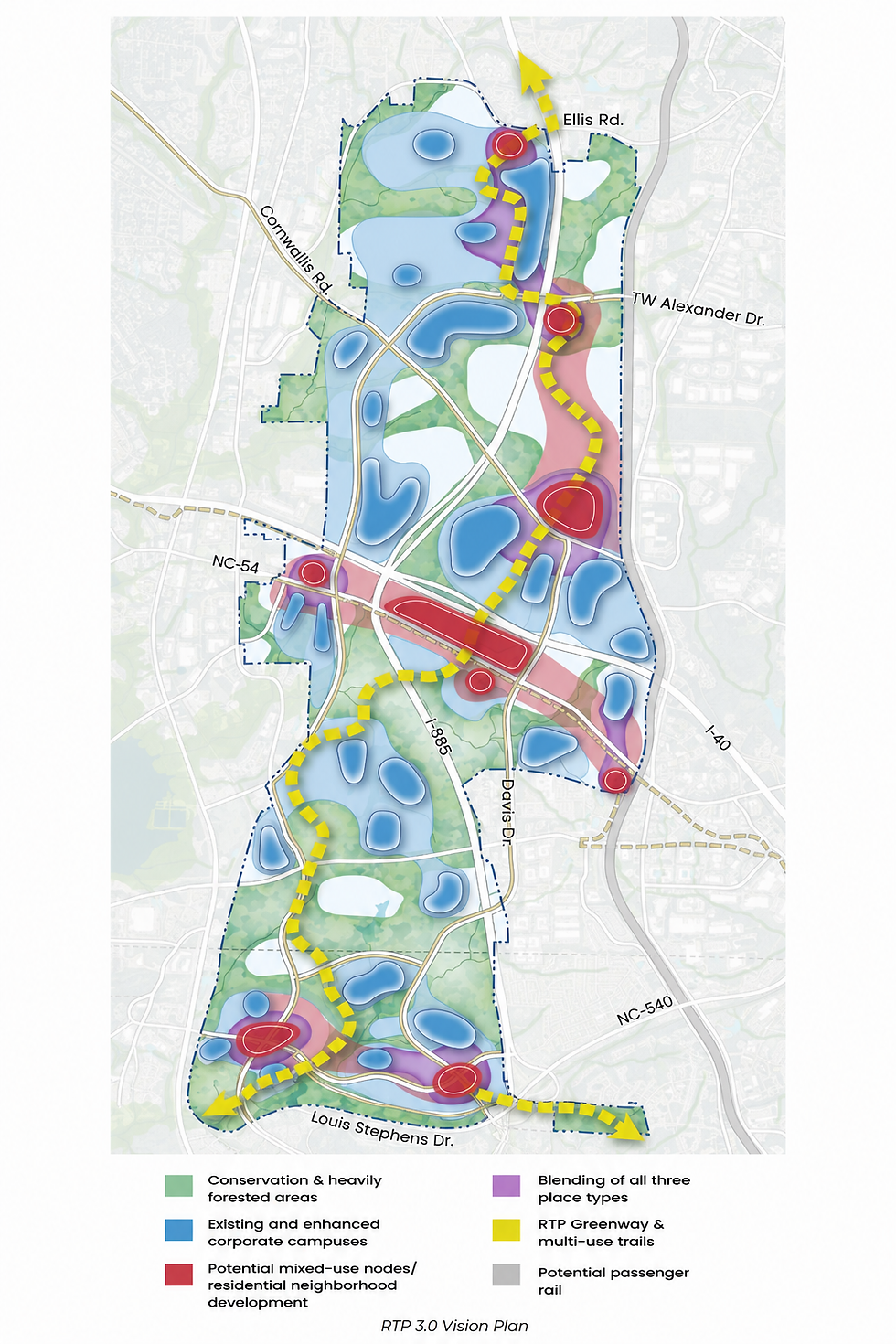
Research Triangle Park is entering one of the biggest transformations in its history.
RTP 3.0, approved in mid-2026, creates a long-term framework allowing substantially more residential, retail, office, lab and mixed-use development within Research Triangle Park.
For decades, RTP has primarily been a place people commute to. RTP 3.0 creates the possibility of something very different: a place where substantially more people could eventually live, work, shop and spend time within the park itself.
For homeowners and buyers in Cary, Morrisville and Durham, this raises an important real estate question:
Will adding housing inside RTP reduce demand for surrounding communities—or make living near RTP even more desirable?
The answer is likely a combination of both.
RTP 3.0 could gradually add centrally located housing supply while simultaneously making the entire RTP corridor more attractive to employers, professionals and relocating households.
What Is RTP 3.0?
First, RTP 3.0 does not mean tens of thousands of homes are suddenly being built.
It is a flexible, decades-long development framework that gives RTP companies and landowners more options for how their properties can be developed.
The new framework introduces three primary development options alongside RTP's traditional corporate campuses.
Enhanced Corporate Campus
Corporate properties can accommodate greater density and lot coverage, allowing companies to use their land more intensively than under RTP's historically restrictive campus model.
Residential Neighborhood Development
Approximately 500 acres could potentially be eligible for residential development.
One important distinction: detached single-family homes are not part of this development category.
Townhomes represent the lowest-density residential format, while apartments and other higher-density housing can also be developed.
The theoretical maximum capacity has been estimated at approximately 30,000 residential units, but that should not be confused with an actual construction plan.
How many homes ultimately get built will depend on individual landowners, developers, infrastructure, financing and future market demand.
Mixed-Use Nodes
RTP 3.0 also allows denser combinations of:
Housing
Restaurants and retail
Offices
Research and laboratory space
Services
Public and community amenities
We are already seeing an early version of this concept at Hub RTP, where residential development has begun changing a park historically dominated by offices and research campuses.
Long-term projections suggest RTP could eventually accommodate approximately 45,000 residents.
If that happens over the coming decades, Research Triangle Park could evolve into a significant residential center of its own.
Why RTP 3.0 Real Estate Matters for Triangle Real Estate
Research Triangle Park occupies one of the most strategically important locations in North Carolina.
It sits between Raleigh, Durham and Chapel Hill and is closely connected to Cary and Morrisville.
For decades, RTP's concentration of technology, research, pharmaceutical and life-science employers has helped drive housing demand into surrounding communities.
Professionals working in RTP commonly choose to live in Cary, Morrisville, Durham, Raleigh, Apex, Chapel Hill, Holly Springs and other Triangle communities.
RTP 3.0 begins changing that relationship by allowing substantially more housing inside the employment center itself.
But that doesn't necessarily mean demand for surrounding communities will decline.
In some locations, RTP 3.0 could actually make nearby housing more desirable.
Two Forces Will Shape the Housing Market
The potential real estate impact of RTP 3.0 comes down to two forces happening simultaneously:
More housing supply and potentially more housing demand.
More Housing Supply Near Jobs
Building apartments and townhomes inside RTP creates additional options for people who might otherwise compete for housing elsewhere in the Triangle.
Over time, that could help absorb some of the housing demand created by continued population and employment growth.
Renters and buyers who prioritize proximity to work may increasingly have the option of living directly within RTP.
This could create additional competition for apartments and townhomes in surrounding communities.
A More Desirable RTP Could Also Create More Demand
There is another side to the equation.
A more vibrant RTP could become an even stronger tool for attracting companies and employees to the Triangle.
Housing, restaurants, retail, public spaces, walkability and future transportation improvements could transform RTP from primarily an employment destination into a more complete community.
If that attracts additional investment, companies and high-income professionals, housing demand throughout surrounding communities could increase.
In other words:
RTP 3.0 creates more housing—but it may also create more reasons for people to move to the Triangle.
That is why the effect on home values is unlikely to be as simple as "more supply means lower prices."
What RTP 3.0 Could Mean for Cary
Of Cary, Morrisville and Durham, Cary may be the most insulated from direct competition with new housing inside RTP.
Cary is already a mature and highly desirable suburb with established neighborhoods, parks, greenways, community amenities and a large inventory of detached single-family homes.
Buyers considering the area can explore our Cary real estate guide for more information about Cary neighborhoods, housing options and the local market.
The key distinction is housing type.
RTP's residential framework emphasizes townhomes, apartments and other denser forms of housing rather than detached single-family homes.
Someone looking for an established four-bedroom home with a yard in Cary isn't necessarily choosing between comparable properties inside RTP.
That should help protect Cary from some of the direct housing competition RTP 3.0 could create elsewhere.
West Cary Could Be Particularly Well Positioned
West Cary is especially interesting.
Major transportation corridors such as NC-540 provide convenient access to RTP while allowing residents to maintain a more traditional suburban lifestyle.
For RTP professionals, the value proposition could remain compelling:
Live close to work while retaining access to Cary's established neighborhoods, detached homes, parks
and community amenities.
Newer communities also attract buyers seeking contemporary floor plans and modern amenities.
Buyers considering this part of the Triangle can also explore new construction homes in Cary, Apex and the Triangleto compare communities, builders, floor plans and locations.
As RTP becomes a more active employment and mixed-use destination, convenient access could become an even stronger advantage for nearby Cary communities.
That doesn't mean RTP 3.0 will automatically push Cary home prices higher.
Interest rates, inventory, school assignments, neighborhood desirability, condition and the overall economy will remain much larger short-term influences.
The RTP effect should be viewed as gradual and structural rather than immediate.
What RTP 3.0 Could Mean for Morrisville
Morrisville may have the most interesting relationship with RTP 3.0.
The town sits immediately adjacent to Research Triangle Park and has long benefited from its position within the Triangle's technology corridor.
That means Morrisville could experience both the benefits and competitive effects of RTP's transformation.
The Potential Upside
A stronger RTP could reinforce Morrisville's appeal among technology professionals and relocating households.
Residents could eventually gain convenient access to additional:
Restaurants
Retail
Entertainment
Employment
Transportation connections
Public spaces
Community amenities
without necessarily needing to live inside RTP.
Morrisville could effectively become an established residential counterpart to a more urbanized Research Triangle Park.
The Competitive Side
New RTP housing could also compete more directly with Morrisville than with Cary.
Someone currently renting an apartment or buying a townhome in Morrisville primarily because of the RTP commute may eventually have more housing options inside the park.
That additional supply could moderate rapid appreciation in certain housing categories over time.
However, established Morrisville neighborhoods will continue offering characteristics that new RTP developments may not replicate.
Housing type, neighborhood environment, school assignment, commute, outdoor space and long-term ownership goals will remain important differentiators.
What RTP 3.0 Could Mean for Durham
Durham is likely to experience some of the most direct effects because much of Research Triangle Park lies within Durham County.
New residential and mixed-use development could significantly change portions of southeast Durham over time.
That creates both opportunities and challenges.
Potential Benefits
Neighborhoods with convenient RTP access could become increasingly desirable if the park adds restaurants, retail, public spaces and other amenities.
New development could also bring additional investment and infrastructure to surrounding areas.
Instead of living next to primarily isolated corporate campuses, some Durham residents could eventually live near an active mixed-use district.
Infrastructure Will Be Critical
Growth also creates legitimate concerns.
Transportation, utilities, schools, police, fire and emergency services will need to keep pace with additional development.
Traffic will be particularly important.
Building housing closer to employment can reduce commuting distances for some residents.
But adding thousands of residents, businesses and visitors also creates additional local traffic.
The eventual outcome will depend heavily on where development occurs and what infrastructure is built alongside it.
Southeast Durham will therefore be one of the most important areas to watch as the first RTP 3.0 projects emerge.
Will RTP 3.0 Lower Home Prices?
Probably not in the simple way some buyers might expect.
Adding more housing supply can help absorb future Triangle population growth and potentially reduce some of the extreme supply pressure the region has experienced.
But RTP 3.0 does not suddenly put 30,000 completed homes on the market.
Development will occur gradually.
At the same time, the Triangle continues attracting residents, businesses and investment.
RTP 3.0 is better understood as a long-term response to regional growth, rather than a sudden source of excess housing inventory.
Housing type also matters enormously.
An apartment inside RTP doesn't directly replace a detached home in Cary.
A future RTP townhome may compete more directly with certain Morrisville properties.
A Durham home near a future mixed-use node could benefit from new amenities while also experiencing greater density and traffic.
Real estate remains hyper-local—even when the development plan is regional.
RTP 3.0 Could Matter Even More for Triangle Relocation
One of the most interesting effects could involve people relocating to the Triangle for technology, pharmaceutical, life-science, healthcare or university-related careers.
Historically, someone accepting a position in RTP needed to decide where outside the park to live.
Future employees could have another choice:
Live directly in RTP.
But many relocating households will still prefer traditional neighborhoods.
A family relocating from New York, New Jersey, California or another higher-cost market might compare:
RTP: shorter commute + denser mixed-use lifestyle
Morrisville: extremely convenient RTP access + established residential communities
Cary: short commute + larger selection of detached homes + established community amenities
Durham: proximity to RTP + access to Durham's broader urban and cultural environment
That creates more housing choices rather than necessarily making one community the winner.
For people considering a move to the region, our Triangle relocation resources can also help compare Cary, Raleigh and surrounding communities based on housing, location and lifestyle.
Could RTP Eventually Become Its Own Residential Destination?
Potentially.
This may ultimately be the most significant part of RTP 3.0.
Historically, the Triangle has had several major residential centers surrounding a large employment center.
RTP 3.0 introduces the possibility that the employment center itself becomes a significant residential community.
Instead of:
Live in Cary → commute to RTP
some households may eventually choose:
Live in RTP → walk, bike or use transit to reach work
Others may prefer:
Live in Cary or Morrisville → enjoy convenient access to RTP's jobs and amenities without living in a dense mixed-use environment.
Those markets can coexist because they serve different buyers.
What Home Buyers Should Watch
If you're considering purchasing a home near RTP, don't make a decision based solely on headlines about 30,000 potential housing units.
Watch what actually gets approved and built.
Project Locations
A project several miles away may have very little effect on a neighborhood.
A major mixed-use development immediately nearby could fundamentally change its environment.
Housing Type
Apartments, condos and townhomes affect surrounding housing markets differently.
Transportation
Transportation investments—including the planned Triangle Mobility Hub and improvements around corridors such as NC-54—could significantly influence which communities benefit most.
Restaurants, Retail and Amenities
A major increase in dining, shopping and public spaces could make nearby neighborhoods more desirable.
Schools and Public Services
Additional population needs supporting infrastructure.
Corporate Investment
New employers and major corporate expansions may ultimately have a greater effect on housing demand than residential development itself.
What Home Sellers Should Watch
For homeowners considering selling a home in Cary, RTP-related employment and relocation demand is only one component of the property's market value.
Neighborhood, condition, renovations, floor plan, lot, presentation and competing inventory can have a much greater effect on what buyers are willing to pay today.
A Cary luxury seller may be targeting an executive relocating for a technology or life-sciences position.
A Morrisville townhome seller could eventually compete more directly with new RTP housing.
A southeast Durham homeowner could potentially benefit from proximity to new amenities.
The impact isn't determined simply by distance from RTP.
It depends on the relationship between your home, its likely buyer and the alternatives available to that buyer.
Blue Orchid Realty also offers Cary-area sellers a 1.5% full-service listing fee, combining professional representation, pricing strategy, preparation and marketing with a lower listing-side fee.
RTP 3.0 Is a Long-Term Story
Perhaps the most important takeaway is that RTP 3.0 is not an overnight transformation.
The framework creates possibilities for development.
It doesn't require every landowner to immediately develop their property.
Actual construction will depend on market conditions, financing, infrastructure and individual property owners.
The clearest signals should emerge as development applications and projects move forward in 2026, 2027, 2028 and beyond.
For Triangle homeowners, RTP 3.0 is something worth watching—but not a reason to make immediate assumptions about property values.
RTP 3.0 represents a major philosophical shift for Research Triangle Park.
The park is gradually moving beyond the traditional suburban corporate-campus model toward a more flexible live-work-play environment.
For housing, that creates two forces at the same time:
More centrally located housing could moderate some future supply pressure, while a more vibrant RTP could strengthen employment, relocation and housing demand throughout the surrounding region.
Morrisville and southeast Durham are likely to experience the most direct effects.
Cary should be more insulated from direct competition because its established single-family neighborhoods offer a different housing product from the denser residential development envisioned within RTP.
Ultimately, some of the strongest locations may be communities that offer easy access to RTP while providing housing and lifestyle choices that aren't easily replicated inside the park itself.
Buying or Selling Near Research Triangle Park?
Blue Orchid Realty helps buyers and sellers throughout Cary, Morrisville, Raleigh, Durham and the greater Triangle.
Emme Zheng, Broker-in-Charge and co-founder of Blue Orchid Realty, combines more than 14 years of Triangle real estate experience with a background in Interior Architecture.
For buyers, that means evaluating more than location and price—including neighborhood differences, floor plans, lot selection, new construction and long-term resale considerations.
For sellers, it means understanding how location, condition, presentation and the property's likely buyer pool affect its competitive position.
Whether you're relocating for an RTP-area employer, considering buying near the technology corridor or wondering how future development could affect your home's position in the market, Blue Orchid Realty can help you evaluate the decision at the neighborhood and property level.


Comments